
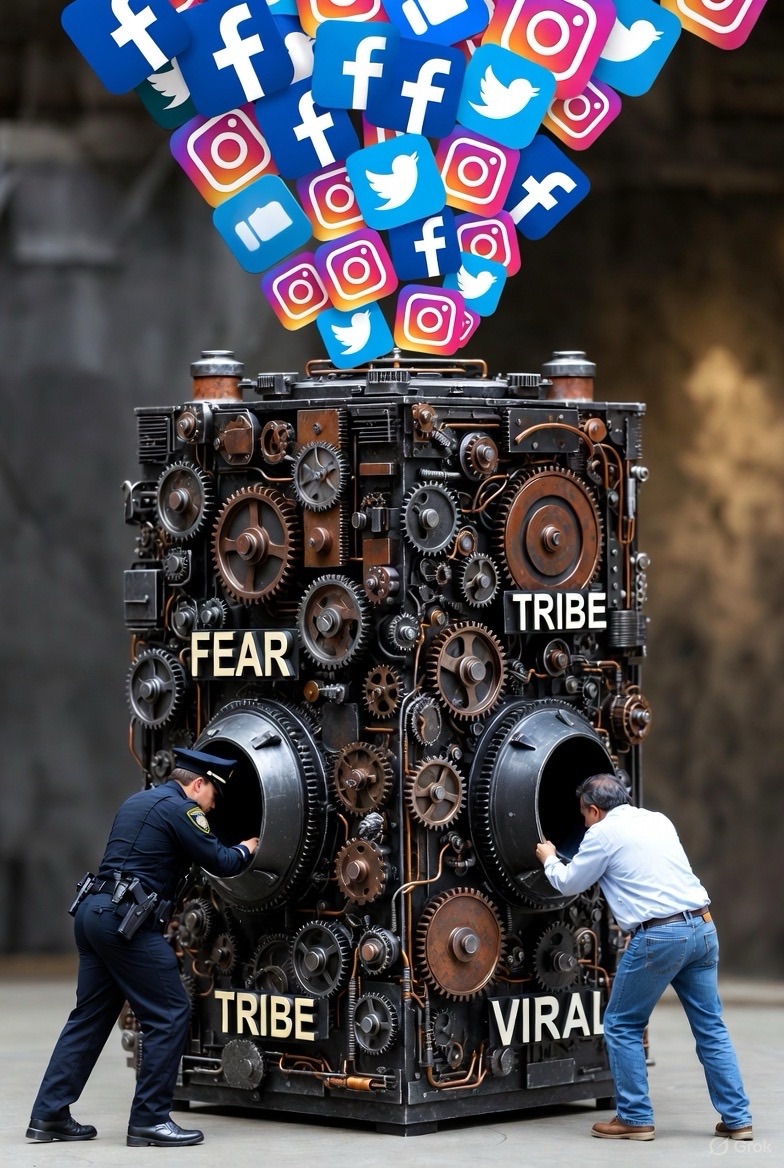
Every week—sometimes every day—we watch the same story play out on our screens.
A police encounter goes wrong. A citizen is injured, detained, or humiliated.
And before the facts are even in, the narrative machine begins cranking in perfect rhythm.
One tribe screams, “Innocent person brutalized by jackbooted thugs!”
The other shouts, “If people would just comply like adults, none of this would happen!”
Two absolutes. Two certainties.
Two worldviews that cannot be true at the same exact time.
Yet here we are—locked in a national psychodrama where both sides insist their version is not only correct, but morally mandatory.
Meanwhile, the actual event, the real humans involved, and the deeper systemic issues get drowned out by the noise.
The Minneapolis ICE Case: A Familiar Script, A Familiar Reaction
The recent ICE raid in Minneapolis—where a U.S. citizen was detained, held, and released only after hours of confusion—checks every box of our cultural script:
A mistaken detention. A use of force that raises questions. A citizen caught in the gears of the system. A crowd forming, tensions escalating, pepper spray deployed. Outrage exploding across the political divide.
Within minutes, the narrative cements:
“See? The police are out of control.” “See? People provoke these situations and then cry foul.”
And just like that, the conversation is over before it begins.
The Impossible Dual Belief: Trust No One, But Also Follow No Instructions
Somewhere along the line, America adopted a strange new belief system:
Law enforcement is a dangerous occupying force that cannot be trusted. Also, citizens should escalate, resist, or refuse identification because “knowing your rights” apparently means behaving like a YouTube lawyer. And simultaneously, we expect that every police encounter will end peacefully.
This is magical thinking.
You cannot treat officers as mortal enemies and assume every choice to escalate will end in a calm, respectful discussion.
On the flip side, you also cannot pretend compliance guarantees perfect professionalism from every officer, every time. Mistakes happen. Misidentifications happen. Poor training happens. And yes—bad policing happens.
But we’ve replaced nuance with tribal loyalty.
Each side demands absolute guilt or absolute innocence, depending entirely on which political jersey the involved parties appear to be wearing.
The New American Ritual: “Refuse Cooperation First, Film Second, Complain Third”
It used to be common sense—not political ideology—that defusing a tense situation keeps everybody safer.
But in the social media era, we’ve invented a new ritual:
Step 1: Refuse cooperation.
Not always maliciously—sometimes out of fear, confusion, panic, or misunderstanding. But increasingly, refusal is encouraged by influencers who treat every police encounter as an audition for civil disobedience theater.
Step 2: Escalate verbally or physically.
Because nothing says “protect my rights” like transforming a routine check into a full-blown confrontation.
Step 3: Record the entire event as evidence of oppression.
The camera is not just a witness; it’s a prop.
Step 4: Outrage mobilizes instantly, regardless of facts.
By the time details emerge, both sides have already committed to their narrative.
It’s theater.
Predictable, exhausting, destructive theater.
What’s Missing From the National Discussion
We never talk about the root cause:
We’ve trained a generation to view law enforcement not as flawed public servants, but as antagonists in a culture war.
Pair that with:
A plunge in community trust A rise in political extremism A media ecosystem that profits from outrage And social platforms that reward the most aggressive interpretations of every interaction —
…and you get the volatile mess we see today.
Policing cannot function when citizens treat every instruction as a political test.
And civil liberties cannot function when law enforcement agencies operate without rigorous accountability.
Both statements are true. Both sides ignore one of them.
The Tragedy: Outrage Wins, Solutions Lose
While tribes wage rhetorical war, real issues go unresolved:
Misidentification and mistaken detentions do occur. Poor training and inconsistent standards do lead to unnecessary force. Escalation from citizens does increase risk and chaos. And political outrage does make reform impossible.
We’re so addicted to blaming “the other side” that we have no vision for a world where cooperation and accountability can coexist.
Imagine that—both responsibilities existing at the same time.
A radical idea in 2025.
A Culture That Forgets Cause and Effect.
Nobody wants to say it out loud, so I will:
Fear-mongering has caused people to believe that refusing to cooperate with law enforcement is a reasonable first move. It’s not.
Refusing identification, resisting physically, shouting, or escalating will never produce better outcomes.
Not because “the cops are always right”—but because cause and effect still exists, even in a digital age.
At the same time, agencies cannot expect full trust when mistakes, misidentifications, and unnecessary force continue happening. Trust is earned, not demanded.
Both sides have responsibilities. Neither side wants them.
Where Do We Go From Here?
We cannot solve this by doubling down on tribal narratives. We cannot solve it by pretending only one group ever makes mistakes.
And we definitely cannot keep pretending that both extremes are simultaneously correct.
What we need is simple, but culturally difficult:
Citizens who cooperate first, and challenge misconduct later. Law enforcement that prioritizes de-escalation and professionalism, even under stress. A public that waits for facts before choosing a tribe. A media ecosystem that stops monetizing chaos. And a population that remembers adults once knew how to behave during stressful encounters.
Until then, the cycle continues:
Resist.
Complain.
Repeat.
And the country gets no safer, no saner, and no closer to the truth.
Leave a Reply