
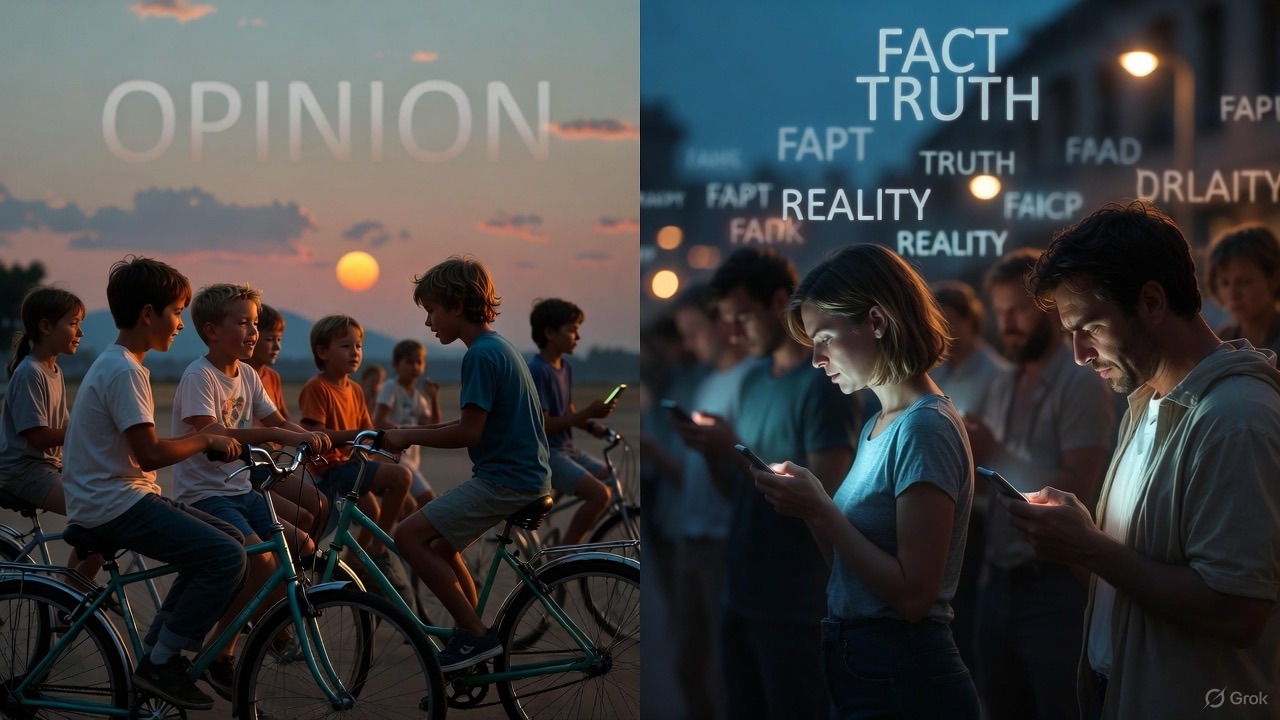
When I was a kid, my friends and I had a pretty simple understanding of how the world worked. There were facts, and there were lies. There was reality, and there was fantasy.
If you weren’t involved in the truth, you were a liar. If you weren’t involved in reality, you were crazy. And crazy liars? We all knew how to treat them.
With suspicion. Distance. Caution.
That wasn’t cruelty—it was instinct. A basic survival filter.
But here’s the thing: back then, we also had another category that mattered just as much.
Opinion.
We said things like, “This is what I think.” We understood that thinking could change.
That two people could see the same situation differently without one of them being dangerous or dishonest.
Somewhere along the way, that category disappeared. The language changed—quietly
Listen to how people speak now:
“These are the facts.”
“I’m just speaking my truth.”
“The reality of the situation is…”
Those phrases sound confident. Even responsible. But pause for a moment and ask yourself:
What happens to the person who disagrees? If you disagree with facts, you must be lying. If you disagree with truth, you must be immoral or dishonest. If you disagree with reality, you must be… unstable.
Crazy.
And we all know how we treat crazy people, don’t we? Don’t we instinctively keep them at arm’s length?
Don’t we feel a quiet sense of threat around someone we think isn’t grounded in reality?
This isn’t political. Its. psychological.
The moment disagreement became dangerous
Think about your own life for a second.
Have you ever avoided a topic around a coworker—not because it mattered, but because you didn’t want the tension?
Have you ever learned to nod along with a family member just to keep the peace?
Have you ever quietly re-categorized someone you love as “someone you can’t really talk to about certain subjects?”
What changed? Was it really the belief itself? Or was it the way disagreement started to feel unsafe?
When opinions are framed as facts, disagreement stops being intellectual and starts becoming personal. You’re no longer debating ideas. You’re defending your sanity and your honesty.
That’s not a fair fight.
Why this works on us
Our brains didn’t evolve for Twitter, cable news, or comment sections. They evolved for small groups—tribes—where:
Liars were dangerous. Unstable people were unpredictable. Reality-breaks threatened group survival.
So when language subtly frames disagreement as deception or delusion, it presses ancient buttons.
Your nervous system doesn’t say, “Ah, an alternative interpretation.”
It says, “Something’s off here.”
And once that alarm goes off, curiosity shuts down and the conversation turns to a battle.
This is why you don’t feel calm in these conversations. This is why people talk past each other. This is why the volume keeps rising.
“I’m just stating reality”
That phrase is especially powerful.
Because what does it imply? That there is one reality, which is already known. And that anyone who doesn’t accept it is choosing fantasy or “crazy town.”
But life is rarely that simple.
Most of what we argue about today—politics, culture, identity, risk, morality—never shows up in our kitchens or driveways the next morning, only in our debates.
What does show up is distance, silence, and stained relationships.
Isn’t it strange that ideological beliefs with almost no daily impact on our lives have somehow gained the power to fracture families and friendships?
Have you ever stopped and asked why?
The cost we don’t talk about
We’ve normalized a style of speech that quietly encourages us to see each other as:
Dishonest, Irrational, Unsafe
Once someone is placed in that category, we stop extending grace.We stop asking questions. We stop trusting.
And trust, once gone, is hard to rebuild.
The real damage isn’t ideological. It’s relational.
What if we brought opinion back?
What if we simply said:
“This is what I think.”
“I could be wrong.”
“This is how I’m seeing it right now.”
Not as weakness—but as respect.
What if disagreement didn’t automatically mean someone was lying or detached from reality?
What if we made space again for thinking out loud?
Because that’s how humans have always learned.
A final question
When you think about the people you’ve pulled away from—
Was it because they truly harmed you?
Or because the language around belief made it feel like you couldn’t safely disagree anymore?
That question is worth sitting with. Because this way of speaking wasn’t inevitable.
It was learned.
And anything learned can be unlearned.
Leave a Reply