
If you’ve tried to get your air conditioner fixed lately, you may have had the same experience as millions of others: a familiar local brand name on the truck, but the bill looks like it came from Wall Street.
That’s not your imagination. Private equity firms have been quietly rolling up fragmented local industries — HVAC contractors, dental offices, veterinary clinics — and stitching them into national chains. What used to be thousands of small owners competing on service and price has been consolidated into a handful of financial entities.
The pattern is predictable:
Buy up local competitors. Rebrand as “one big family” of companies. Standardize prices and operations. Use the new scale to raise prices and squeeze the customer.
You end up with the same technicians, the same vans, the same phone number — but fewer real alternatives and a lot less pricing pressure.
Now zoom that model out from your thermostat… to your news, your entertainment, and the narratives that tell you what’s “normal.”
Private Equity and the Vet Bill That Suddenly Doubled
The veterinary world is experiencing the same story, only faster.
Billions in private equity money have flowed into the vet sector, buying small community practices and rolling them into corporate chains. Regulators have begun sounding alarms, warning that consolidation reduces choice, pushes out independent clinics, and often leads to higher prices and lower quality.
Pet owners have felt it directly: over just a few years, veterinary costs have surged dramatically — not because your vet suddenly became greedier, but because the ownership behind the scenes changed. The incentives changed. Profit targets changed.
And when ownership changes, incentives always change.
The structure may look “local.” The name on the door may be familiar. But the operating philosophy now lives on a spreadsheet in a PE fund’s office — and that changes everything.
From 50 to a Handful: How Media Was Rolled Up
In 1983, roughly 50 companies controlled the majority of American media. By the 2010s, that number had shrunk to about six conglomerates. Today, depending on how you count, the number of true national gatekeepers sits at five or fewer.
This matters because:
A tiny group of executives decides what counts as “serious news,” what’s “too fringe,” and which stories receive massive promotion. Cross-ownership lets narratives echo across film, TV, talk shows, and “news” under a unified corporate umbrella. If one conglomerate decides a topic is radioactive, it quietly vanishes across multiple platforms at once — not through a conspiracy, but through aligned incentives.
This doesn’t require marching orders. Consolidated ownership naturally narrows the range of acceptable discourse. It’s structural.
COVID as a Case Study in Narrative Convergence
The COVID era revealed the consequences of narrative concentration.
Most major outlets — across ideological lines — repeated an extremely narrow band of talking points. Debate on risks, trade-offs, and dissenting expert views often vanished from mainstream coverage. Tech platforms collaborated with governments and media groups to decide which ideas were “safe” to circulate. Corrections and reversals arrived years later, only after policies and public emotions were already cemented.
Whether one believes this was intentional manipulation or institutional groupthink, the result was the same: a small number of controlling entities shaped the nation’s reality.
When ownership is fragmented, no single perspective can dominate.
When ownership is consolidated, one approved narrative can sweep across society with unprecedented speed.
Enter the Netflix–Warner Bros. Deal
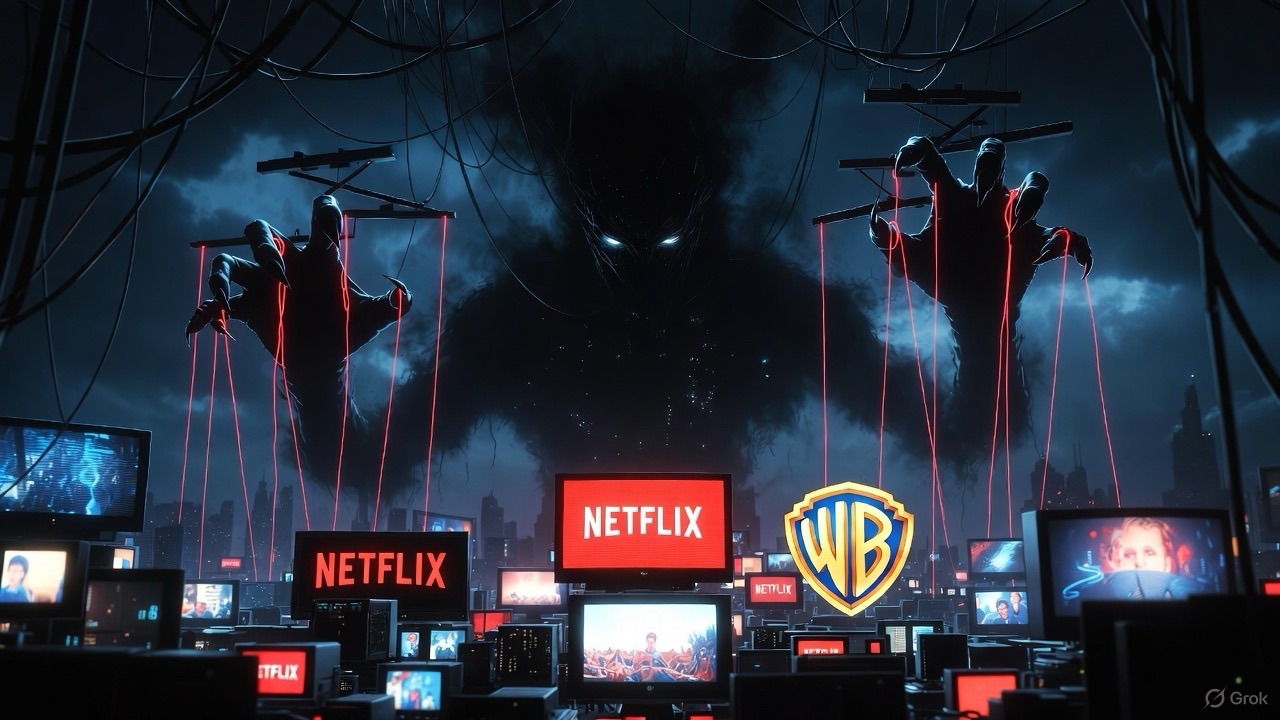
That brings us to today’s looming mega-merger: Netflix’s attempt to acquire Warner Bros. Discovery — including HBO, WB Studios, and some of the most influential cultural franchises on Earth.
If successful, Netflix would control:
Harry Potter, Game of Thrones, The entire DC Universe, HBO’s prestige library, Warner Bros.’ massive film catalog, and a newly absorbed HBO Max under its platform
Regulators, analysts, lawmakers, and even consumer groups are already raising concerns. A merger of this size would:
1. Reduce Real Choice While Preserving the Illusion of Choice
You’d still see a screen full of thumbnails, but a single company would now determine:
Which stories get told Which characters become culturally iconic Which narratives receive prestige budgets Which ideas are quietly downranked by the algorithm
It’s your HVAC story, just scaled up: same brand appearances, fewer true options.
2. Consolidate Narrative Power Into One Algorithm
Netflix would own the most-watched franchises and the most influential streaming algorithm in the world.
That means it would have unprecedented influence over:
How political institutions are portrayed, which cultural values get normalized, how dissenters or skeptics appear on screen, and how sensitive topics are framed in documentaries and dramas
People underestimate this: the stories we binge become the boundaries of what we imagine.
3. Tighten the Loop Between Politics, Outrage, and Culture
We are already seeing political actors trying to pressure regulators — not based on antitrust law, but on ideological fears about who controls the narrative.
If the merger happens, a future government or activist group will only need to pressure one dominant streaming company to shape cultural perception.
That is the opposite of a healthy information ecosystem.
Why This Isn’t “Just Another Merger”
It sits at the intersection of three dangerous trends:
Private equity roll-ups turning decentralized industries into oligopolies. Media consolidation shrinking the number of cultural gatekeepers. Algorithmic curation acting as an invisible editor of public consciousness.
Together, they create:
Less diversity of opinion, faster spread of one dominant narrative, more emotional manipulation, more predictable, compliant populations, less democratic resilience in times of crisis
When all your options for news, entertainment, and information are owned by a few entities, you don’t need censorship — the boundaries of thought enforce themselves.
What We Can Do Now
We won’t rewrite antitrust law here, but we can shift behavior:
1. Name It
Stop pretending these mergers are boring financial news. They shape culture and democracy.
2. Support Independent Voices
Independent journalism, independent filmmakers, and decentralized platforms matter more than ever.
3. Diversify Inputs on Purpose
Don’t let corporate algorithms dictate your worldview. Seek long-form content, primary sources, and writers outside the mainstream.
4. Push Back on “It’s Just Business”
People said the same about HVAC roll-ups — until their bill tripled.
5. Watch the Netflix–Warner Deal Carefully
Observe how:
Media covers it, politicians respond, regulators frame it, and other corporations position themselves
This merger will tell us a great deal about whether the next decade of American culture is built on plurality — or consolidation.
Closing Thought
When your AC breaks and the only “choice” left is a corporate-owned conglomerate, you feel it in your wallet.
When your media consolidates and narrative choices shrink to a handful of corporate editorial boards, you feel it in your mind — your assumptions, your fears, your conversations, your sense of what can and can’t be questioned.
The Netflix–Warner Bros. merger is not a side-story.
It is a structural shift in control over the stories that shape society.
We ignore it at our own risk.
Leave a Reply