
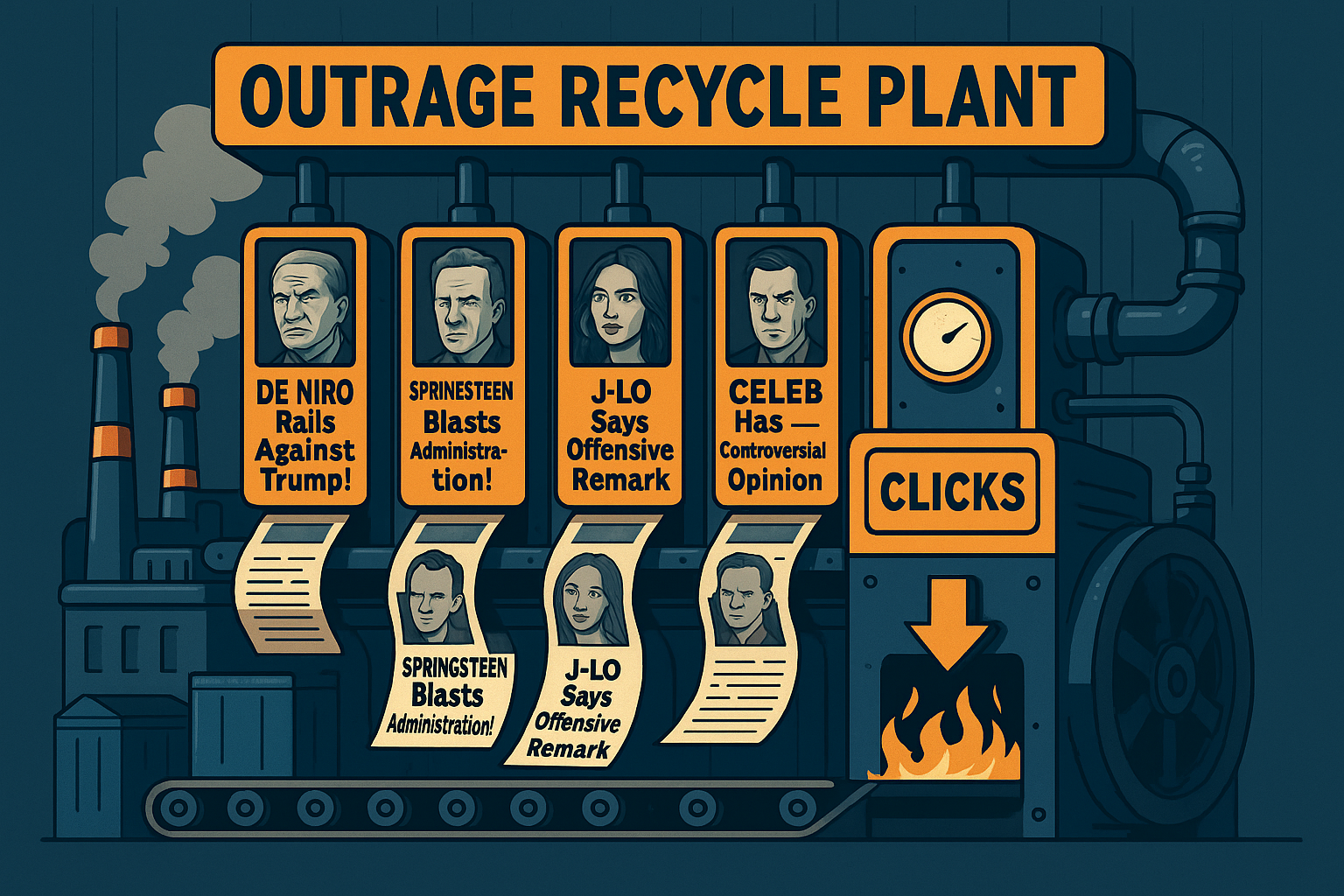
When the outrage machine runs out of gas, it doesn’t stop — it just starts burning old headlines.
Case in point: a 2016 video of Robert De Niro calling Donald Trump a “punk, dog, pig, and con artist” suddenly resurfaced in November 2025 — nearly a decade later — racking up hundreds of thousands of views as if it were breaking news.
It’s the media equivalent of reheating week-old fast food and calling it gourmet.
There’s no context, no relevance, no new development — just the digital equivalent of shaking the cage to see which side will start screeching first. Because they know we will. We always do.
Welcome to the Outrage Recycle Bin
Outrage has a shelf life. Every now and then, the system has to rotate the stock.
When there’s no fresh scandal or culture-war grenade to toss into the feed, the machine digs deep into its archives for “Previously on Outrage Media.”
It’s like a rerun of a reality show you swore you’d stopped watching — but here you are again, scrolling, fuming, commenting, quote-tweeting, as if the same script from 2016 somehow gained new meaning in 2025.
And it’s not just De Niro. The same week, Bruce Springsteen’s old political comments made the rounds again. Coincidence? Hardly. This is algorithmic necromancy — the resurrection of outrage corpses for one last engagement harvest before the feed moves on to the next dopamine drip.
Recycling Rage for Fun and Profit
Think about how efficient this cycle is:
No new journalism required. Just dig up an old clip, repackage it, and call it “trending.” No fact-checking risk. The comments were made years ago, so they’ve already been litigated a thousand times. Guaranteed engagement. Half the audience will rage-share it; the other half will rage-defend it. That’s two clicks for the price of one.
The outrage economy is the only market that thrives on inflation — the same emotional product costs us more every year, yet we keep paying.
Celebrity Outrage Is the Easiest Currency There Is
Celebrities are the preferred delivery mechanism for outrage because they blur the line between fame and authority.
A Hollywood actor’s opinion about policy carries no weight in the real world — but online, it’s like catnip for the emotionally invested. It’s not even about what they said; it’s about how their name can anchor a tribal response.
When Robert De Niro insults Trump, one side screams “legend!” and the other screams “lunatic!” But no one asks why the clip is resurfacing now, or who benefits from reigniting that particular feud.
Spoiler: it’s not you.
The Algorithm Has No Memory — Only Triggers
The internet doesn’t care about context. It only cares about engagement velocity.
The faster people react, the more it promotes the content.
So when you see a “breaking” clip that’s nearly ten years old, remember: it’s not resurfacing because it matters again. It’s resurfacing because it works again.
The algorithm doesn’t care if the outrage is justified or absurd. It only asks:
“Will this make people click, argue, and stay?”
If the answer is yes, the machine hits replay.
Outrage Fatigue Is the Point
It’s tempting to believe that this endless recycling of division is a sign of desperation — that maybe, finally, people are waking up.
But that’s part of the illusion too. The goal isn’t to keep you angry forever. It’s to wear you out until nothing surprises you. Until you see a headline like “De Niro Calls Trump a Pig” and scroll past without blinking — but still subconsciously feel the tug of tribal identity just enough to stay inside the ecosystem.
That’s not journalism. It’s conditioning.
The Real Sequel We Need
If there’s one thing we should learn from this endless rerun, it’s that the outrage machine is terrified of silence. Silence kills engagement. It kills the algorithm. It breaks the trance.
The antidote isn’t more fighting; it’s disengagement.
The revolution isn’t in the comments section — it’s in the refusal to feed the beast.
We can’t control what the machine publishes. But we can control whether we bite.
So next time you see another reheated feud between a celebrity and a politician, just remember:
That’s not news.
That’s leftovers.
And you don’t have to eat it.
#DontBeAClick
Leave a Reply