
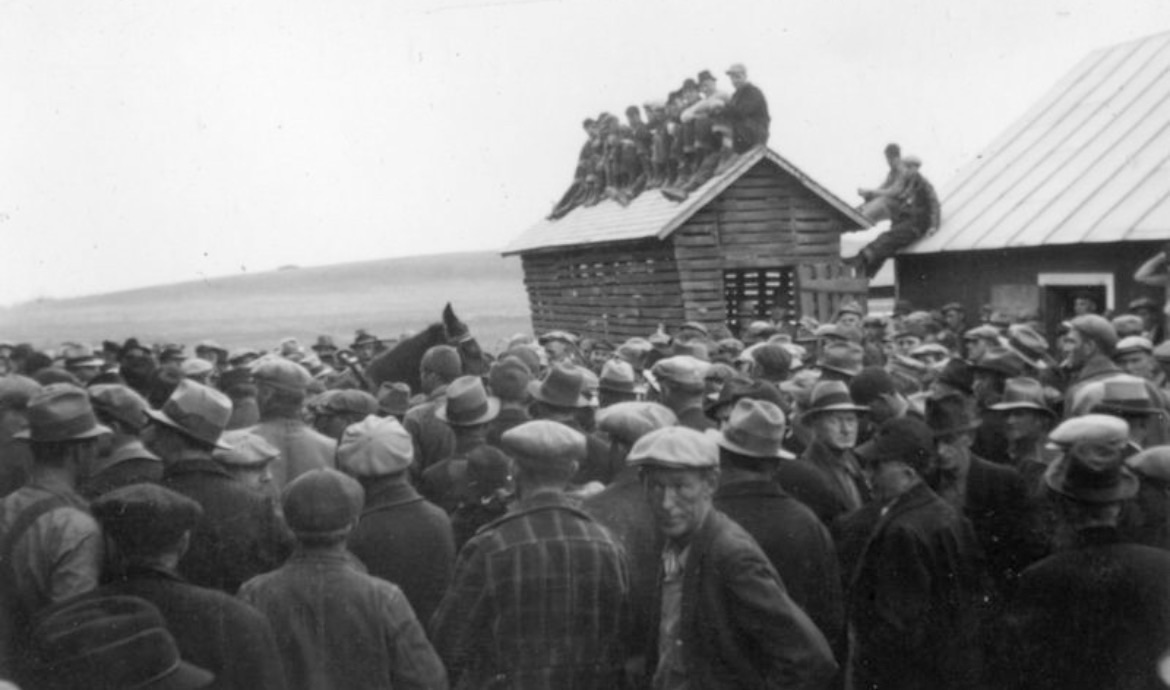
In the depths of the Great Depression, when drought and collapsing crop prices pushed thousands of American farm families to the brink, something remarkable happened across the Midwest. At foreclosure sales—often held by county sheriffs—neighbors showed up en masse. They didn’t come to bid competitively. They came to end the auction.
These events became known as penny auctions. The crowd would intimidate outside bidders into silence, sometimes through words, sometimes through sheer presence. There are even old photos of nooses hanging from the rafters, a not-so-subtle intimidation tactic. One neighbor would then bid a token amount—pennies or a few dollars—win the sale, and quietly return the land or equipment to the original owner. Sheriffs often looked the other way. Bank agents frequently withdrew. Everyone knew everyone. And that knowledge mattered.
This wasn’t chaos. It was community enforcement of an unwritten rule: we survive together or not at all.
Groups like the Farmers’ Holiday Association helped organize resistance, but the real power wasn’t centralized. It lived in relationships—families whose kids went to school together, neighbors who shared labor at harvest, towns where reputations lasted a lifetime.
Why Penny Auctions Worked
Penny auctions succeeded for reasons that are almost unthinkable today:
Reciprocal relationships: Everyone involved depended on everyone else.
Social consequence: A bank manager who pressed too hard would face neighbors at church, at school events, at the feed store.
Shared risk: If one farm fell, the land value of all farms fell. Solidarity wasn’t ideological—it was practical.
Local authority with a human face: The sheriff knew the family. The banker knew the kids. Law was filtered through relationship.
The system bent because the community was real.
Now Ask Yourself This
Try this simple exercise—don’t Google, don’t check your phone:
Can you name 12 neighbors on your street? Can you name them in order of where they live? If your house were threatened—financially, legally, physically—who would show up? Would it be the neighbor with the opposing political sign in their yard? Or would it be a wealthy influencer you “follow,” living in a gated community, thousands of miles away?
Be honest.
The Great Swap: Neighbors for Screens
Something fundamental has changed. We’ve traded reciprocal community for one-way spectatorship.
Today’s “community” often exists entirely on screens:
You click. They get paid. You receive dopamine, identity reinforcement, and the illusion of belonging.
But when the chips are down, that relationship is revealed for what it is: non-reciprocal. Influencers don’t know your name. Platforms don’t show up with casseroles, tools, or legal cover. Algorithms don’t stand between you and power.
Meanwhile, real neighbors—people who might actually help—are sorted into enemy camps by political branding, reduced to lawn signs and social labels. The very people who would have stood shoulder-to-shoulder at a penny auction are now trained to distrust one another.
Why Entrenched Power Is Now Limitless
The penny auctions were dangerous—to banks, to centralized power—because local communities could still resist. Today, resistance is fragmented, performative, global, and monetized.
A divided, screen-bound population:
Can be outraged indefinitely without acting. Can be mobilized emotionally without building trust. Can be guided by people who never share their risk.
Entrenched Power loves this arrangement.
The Question That Matters
So here’s the uncomfortable question the penny auctions ask us across time:
If something truly went wrong tomorrow—foreclosure, disaster, unjust pressure—who would stand with you in the physical world?
Not who would retweet.
Not who would post a heart emoji.
Not who would monetize your pain into content.
Who would show up?
The penny auctions weren’t just about farms. They were proof that community once had teeth. If that kind of solidarity feels impossible today, it’s worth asking why—and what we’re willing to rebuild.
Because systems only have limitless power when the people facing them stand alone.
Go across the street. Ignore that political sign in the yard or the bumper sticker that pisses you off.
Introduce yourself and bring a gift.
Leave a Reply