
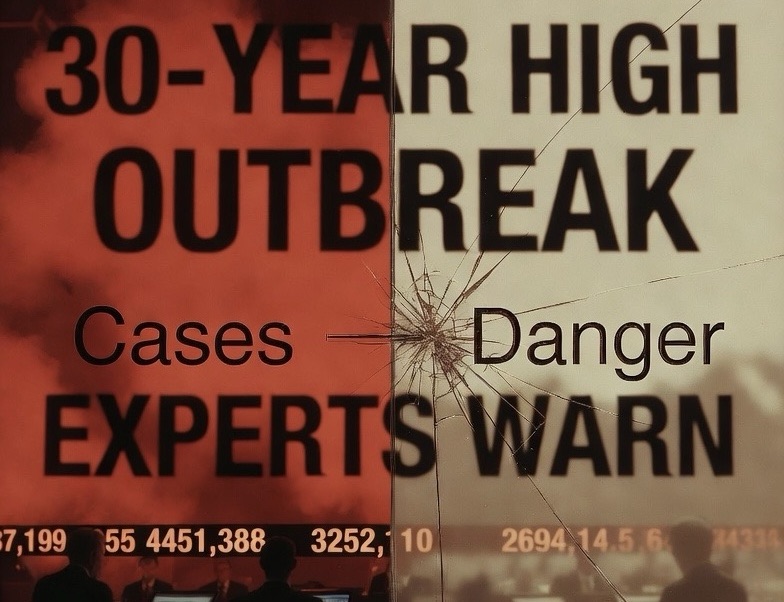
If you’ve been consuming mainstream news lately, you’ve likely seen the same breathless headline repeated over and over:
“Measles cases hit a 30-year high.”
“Over 2,000 cases for the first time in decades.”
“Experts warn this is a major public health threat.”
The numbers themselves are not fabricated. The framing, however, is deeply dishonest.
This is a textbook example of fear amplification through selective context—a familiar pattern in modern media where technically true data is stripped of historical and medical perspective to manufacture urgency, outrage, and political pressure.
Let’s put the facts back where they belong.
Case Counts Are Not the Same Thing as Danger
The modern public has been trained—intentionally or not—to interpret case counts as a proxy for severity. This is a critical error.
A “case” of measles today includes:
Mild infections, Self-resolving childhood illness, Cases detected due to far more aggressive surveillance and reporting
What matters in public health is:
Hospitalizations – Complications – Deaths
And on those metrics, measles was already largely defanged before any vaccine existed.
The Forgotten Fact: Measles Deaths Collapsed Before Vaccination
The measles vaccine was introduced in the United States in 1963. By that point, the danger narrative had already collapsed.
Historical reality:
In the early 1900s, measles caused thousands to tens of thousands of deaths per year in the U.S. By the 1940s and 1950s, measles deaths had fallen by over 90%. This decline occurred before the measles vaccine was introduced
Why?
Because of:
Improved nutrition – Clean water – Sanitation – Reduced overcrowding – Better general medical care – Supportive treatments for fever and dehydration
This same pattern appears across nearly every infectious disease:
mortality plummets first; vaccines arrive later.
Vaccines did not rescue humanity from mass measles death.
Modern living conditions did.
This is not controversial history—it is standard epidemiology.
The Modern Measles Reality (Which Headlines Avoid)
Today in the United States:
Measles deaths are rare, Severe complications are uncommon, The vast majority of cases resolve without incident
Even with a “30-year high” in reported cases, the outcomes look nothing like the pre-industrial disease that headlines implicitly evoke.
But the language is carefully chosen to activate fear, not understanding.
Why “30-Year High” Is a Psychological Trick
The phrase “30-year high” is not medical language. It is emotional framing.
It exploits:
Short public memory – Lack of historical baselines – Confusion between cases and consequences
A 30-year window conveniently excludes:
The era when measles was nearly universal – The era when deaths were already collapsing – The era when measles was considered a routine childhood illness
The implication is always the same:
“Something has gone terribly wrong.”
But the data does not support that implication.
The Political Subtext No One Is Supposed to Notice
This reporting did not arise in a vacuum. The amplification of measles fear has coincided with:
Leadership changes at HHS – Public skepticism toward pharmaceutical authority – Broader cultural reevaluation of risk communication
Instead of discussing:
Risk stratification – Honest outcome data – Historical context
The media has chosen:
Alarmist language, Moral framing, Implicit blame narratives
This turns a public-health discussion into a political loyalty test. That has nothing to do with health.
A Sober, Adult View of Measles
None of this requires denying that measles exists. None of this requires claiming cases are fabricated. None of this requires rejecting modern medicine.
It requires something far simpler:
intellectual honesty.
The truth is:
Measles is real, Cases fluctuate, Outcomes today are dramatically less severe than in the past, The danger is being rhetorically inflated for effect
Fear is not a substitute for data. Language is not a substitute for truth. And history cannot be erased just because it undermines a narrative.
The Pattern Should Look Familiar
If this all feels familiar, it should.
The same structure has been used repeatedly:
Select a technically true statistic – Strip away historical context – Amplify emotional language – Frame dissent as recklessness – Convert health into politics
This is not public health communication. It is narrative management.
And once you see it, it’s impossible to unsee.
Bottom line:
The measles headlines are not about protecting children. They are about protecting a story.
And stories thrive on fear.
Leave a Reply