
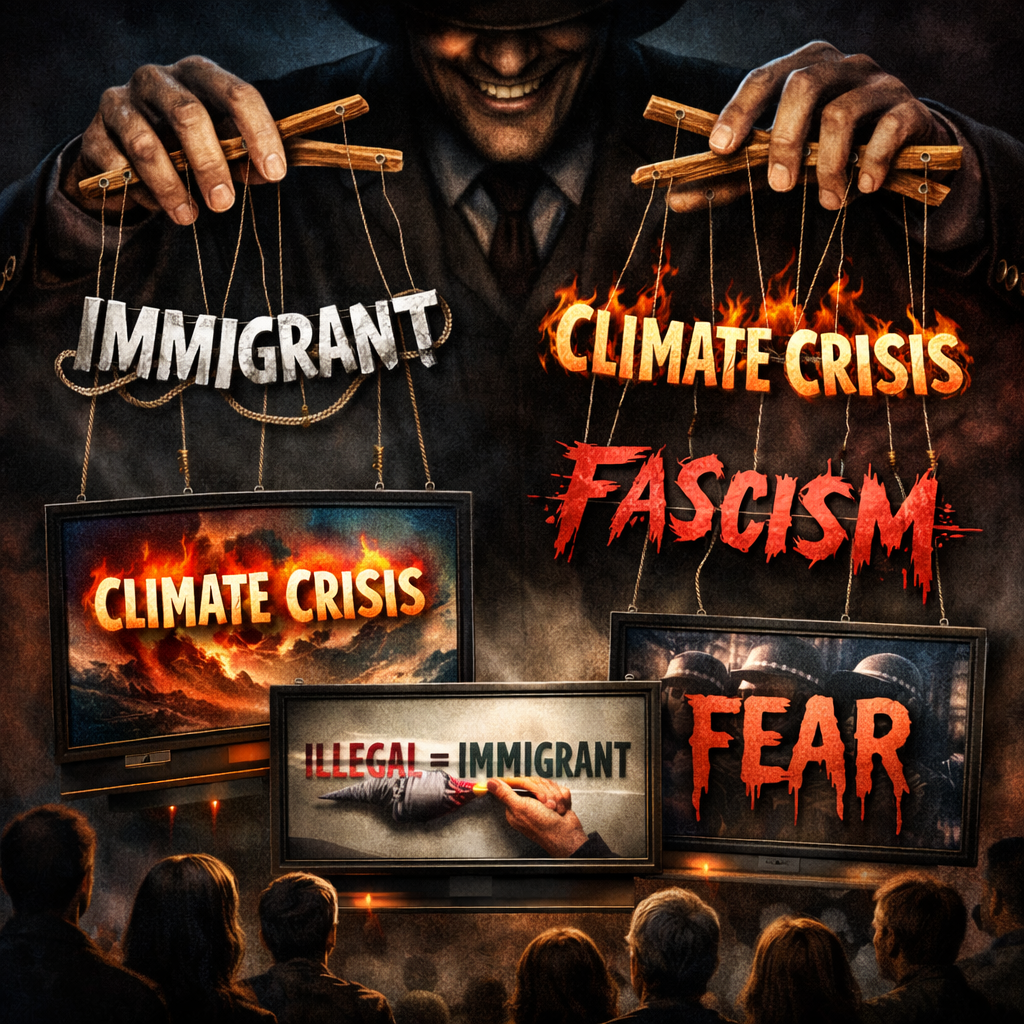
There is something deeply unsettling happening in this country, and it has almost nothing to do with immigration, climate, or any single political figure.
It has to do with language, not sloppy language, not emotional language.
Weaponized language.
We are living through a period where words are being deliberately redefined, softened, broadened, or emotionally inflated—not to clarify reality, but to distort it. And once language is distorted, perception follows. Once perception follows, fear takes over. And once fear takes over, people stop thinking.
This is not accidental. It is not organic. And it is not harmless.
When Reality Doesn’t Change, But the Words Do
Here’s a simple diagnostic question everyone should learn to ask:
Did the underlying reality change, or did only the words used to describe it change?
In many of today’s most emotionally charged headlines, only the words changed.
Global Warming Became Climate Change
Then Climate Change Became Climate Crisis
Originally, global warming described a specific, measurable phenomenon: a long-term rise in average global temperatures. It was narrow. Testable. Falsifiable. The Earth is warming and it’s a crisis.
“But record low temperatures were recorded globally this week”
Then the language shifted to climate change—a broader, more ambiguous term that could include virtually any weather deviation.
Now we have climate crisis, a term that implies:
Imminent catastrophe, moral urgency, a need for immediate compliance.
Cold snap? Climate crisis.
Heat wave? Climate crisis.
Flood? Climate crisis.
Drought? Climate crisis.
Once every outcome confirms the theory, the theory is no longer a scientific claim—it is a belief system.
The Most Dangerous Linguistic Swap of All
If the climate language drift widened fear, the immigration language drift erased clarity entirely.
Illegal Immigrant → Immigrant
This single omission does more psychological work than most people realize.
The word illegal describes status, not worth. The word immigrant describes identity, not legality.
By removing the adjective, the distinction disappears.
And when distinctions disappear:
Legal residents feel targeted, naturalized citizens feel threatened, enforcement feels arbitrary.
Suddenly, everyone becomes vulnerable. This is not compassion. It is semantic sabotage.
How Law Enforcement Became “Fascism”
One of the most reckless rhetorical escalations in modern discourse is the casual labeling of immigration enforcement as fascist.
Fascism has a definition. Historically, it involves:
Extra-legal punishment, arbitrary authority, suspension of law
Enforcing laws that already exist—laws passed by Congress and signed by previous administrations—is the opposite of fascism.
And yet headlines routinely frame:
Deportation as “ethnic cleansing,” enforcement as “authoritarianism,” border control as “Nazism”
This is not exaggeration for effect. It is moral inversion.
When law enforcement is reframed as tyranny, resistance becomes virtuous. And once resistance is virtuous, escalation becomes justified.
History has seen this movie before.
The Lie That Makes the Narrative Work
All of this language manipulation rests on a foundational falsehood:
“Trump changed the law.”
He didn’t.
Congress did not pass new immigration law. The Constitution did not change. ICE did not receive new powers.
What changed was enforcement.
For years, laws on the books were selectively ignored. When enforcement resumes, it is framed not as governance, but as cruelty. Not as law, but as oppression.
Neglect does not nullify law. Failure to enforce does not make enforcement immoral.
But language can make it feel that way.
Why This Works: The F.A.T.E. Model
People like to believe they are persuaded by facts. They aren’t. They are persuaded by emotional architecture.
F — Focus
The narrative isolates a villain: Trump, ICE, capitalism, “the right.” Ancient fight or flight mechanisms engage (usually fight)
A — Authority
Blue-check accounts, NGOs, and media outlets reinforce the framing.
T — Tribe
Language activates identity: MAGA, fascist, Nazi, racist.
Once tribal labels appear, nuance disappears.
E — Emotion
Fear, disgust, and moral panic override analysis.
If a headline feels urgent, it spreads—even if it’s false.
Why This Is Psychologically Dangerous
When people are conditioned to believe:
Their political opponents are existential threats, law enforcement is tyranny, disagreement equals evil –
…violence begins to feel rational.
Language is always the precursor to escalation. Always. No society collapses because of a single policy. They collapse because language trains people to see enemies instead of neighbors.
Enter The Antidote: C.U.R.E.
Fear only survives in ambiguity. Clarity kills it.
C — Calm
Pause. Headlines are designed to hijack your nervous system.
U — Understand
Ask: What does this word actually mean—legally and literally?
R — Reframe
Translate the headline into plain language.
“Fascist immigration crackdown”
→ Enforcement of existing federal law
E — Exhale
Once ambiguity disappears, fear dissipates.
Why Outrage Is Pointed In One Direction
You may notice something else: this rhetorical onslaught currently flows primarily against one side of the political spectrum.
That isn’t coincidence. Outrage markets follow power dynamics. When one side holds power, media incentives demand opposition outrage—not balance.
This doesn’t make the other side virtuous, it makes the system predictable. Once the other “side” acquires power, the outrage cycle will predictably shift.
The Real Crisis
The real crisis is not immigration. It is not climate. It is not Trump.
The crisis is semantic warfare. When words lose meaning:
Law becomes oppression, enforcement becomes violence, disagreement becomes evil
And when that happens, democracy cannot survive.
Final Thought
When ideology runs out of facts, it attacks language—because whoever controls words controls fear.
And fear, once unleashed, is very hard to put back in its cage.
Leave a Reply