
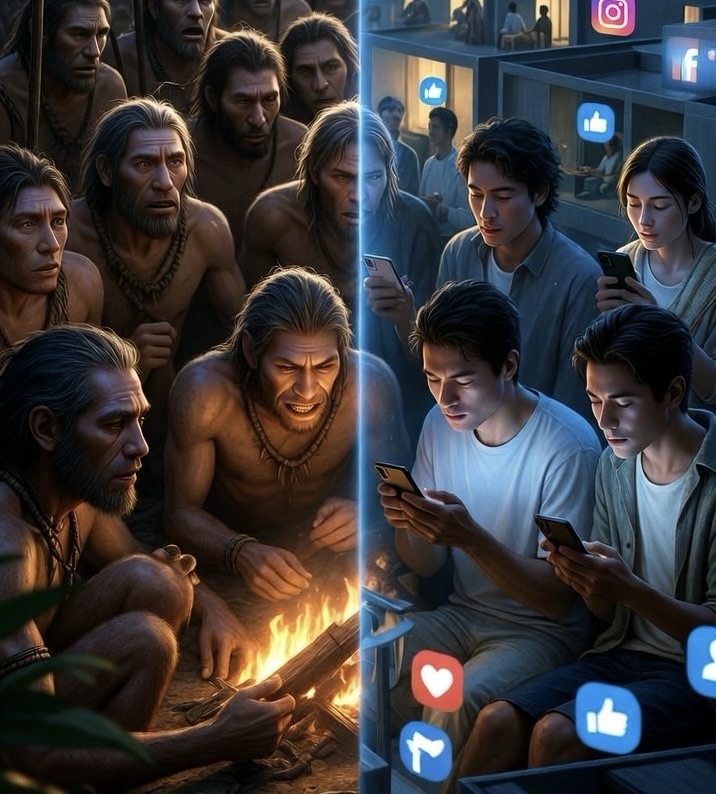
For millions of years, humans survived for one reason above all others: belonging.
A human alone in the wild was a dead human. A child without a tribe was prey. Belonging wasn’t a desire—it was biology, carved into us by evolution as sharply as hunger or fear.
Anthropologists call this deep instinct peer group acceptance, and it is one of the most powerful forces ever produced by natural selection. It kept us alive then, and it governs our behavior now—quietly, invisibly, relentlessly.
And today, that instinct is being weaponized against us.
From the Jungle to Instagram: Same Brain, New World
Ten thousand years ago, the child who failed to integrate into the peer group actually would die.
No protection. No food. No shelter.
The brain, especially the developing brain, encoded this reality as a hard rule:
**Acceptance = Survival
Rejection = Death**
This is why the modern child who cries,
“All the cool kids have these shoes—if I don’t get them I’ll DIE!”
isn’t being dramatic.
To the ancient machinery inside their brain, this is a literal survival calculation. Their biology cannot distinguish between a tiger in the grass and the threat of being socially excluded at school.
The danger is new. But the wiring is ancient. And this wiring does not turn off in adulthood. It simply layers over politics, culture, religion, and identity.
This is why grown adults lose their minds on the internet. Why they defend their political tribe as if guarding a cave entrance.
Why facts bounce off them like pebbles thrown at a fortress wall.
To question the tribe is to risk exile. And exile, to the ancient brain, still means death.
The Rise of the Synthetic Tribe
For most of human history, our tribe consisted of:
The people who lived around us The people who would protect us The people who could save our life in an emergency
The people who depended on us in return
These were small, local communities—face-to-face relationships shaped by cooperation, not ideology.
Today, that entire structure has been destroyed. Instead of relying on neighbors, we rely on strangers online.
Instead of forming local bonds, we form ideological ones.
Instead of community, we have digital tribes with no accountability, no shared fate, and no real loyalty.
We have replaced the people who can actually help us in a crisis with influencers, politicians, and anonymous avatars thousands of miles away.
And the result?
We no longer know our neighbors’ names. We have no community safety net. Half the country is terrified of the other half. We treat differing opinions like existential threats.
The ancient survival instinct has been hijacked.
Why Outrage Media Loves Your Tribal Brain
The system understands this instinct perfectly.
Social media platforms, political operatives, media outlets, and corporate marketing teams all rely on this rule:
If I activate your fear of rejection, I control you.
Every outrage story we’ve analyzed fits the same pattern:
“Republicans want to kill children.” “Democrats want to destroy the military.” “This group is coming to take your rights.” “That group is trying to harm your family.” “Your tribe is under attack—defend it!”
It doesn’t matter whether the story is about:
Hegseth and the drug boat
Trump and the SNAP funding
Vaccines for newborns
Megyn Kelly’s tone
A tragic stabbing
A bureaucratic debate
A misinterpreted quote
A healthcare controversy
The pattern is identical:
**Trigger the survival instinct. Force tribal alignment. Exploit ancient wiring for modern power.**
If the public is scared enough, angry enough, and loyal enough to “their side,” they will never ask for facts. They will never question motives. They will never leave the tribe—even when the tribe hurts them.
This is not an accident. This is engineering.
Why Facts Don’t Matter to the Tribal Brain
Ask someone in a political frenzy,
“Do you want to see the actual data?”
and you’ll often get hostility instead of curiosity.
It’s not because they’re stupid. It’s because their brain thinks you’re threatening their social survival.
To accept evidence that contradicts their tribe is to risk exile.
And exile = death.
Even though that death no longer exists.
This is why a single word—“rapist,” “murderer,” “traitor,” “Nazi”—can shut down half the population instantly.
Not because the claim is true, but because the label signals:
If you disagree, you are no longer one of us.
The brain chooses acceptance over accuracy every time.
Divide, Distract, Dominate
The people in power—media, politics, tech, and even certain public institutions—have learned how to turn this instinct into a profit model.
The formula is simple:
Give people a tribe, Inflame them against an enemy, Reward loyalty with likes, shares, praise, status – Punish disloyalty with shame, isolation, unfriending, or cancellation. Repeat until the population can no longer cooperate
A divided population cannot resist.
A fearful population cannot see clearly.
A tribal population cannot think independently.
And a population that has replaced local community with online tribes is easier to control than any group in human history.
The Cost: We Lost Our Real Tribe
The tragedy is that while we fight strangers online to defend our imaginary tribe, the real tribe—the local one—has disappeared.
Your actual safety net is not someone shouting in your mentions on Twitter. It’s not an influencer with a million followers. It’s not a politician who doesn’t know you exist.
Your real tribe is:
The neighbor who would pull you out of a burning house. The coworker who’d drive you to the hospital. The family down the street who’d lend you food in a crisis. The community that would protect your kids when you’re not there
But we don’t build those relationships anymore.
We don’t trust the people next door. We don’t talk to them. We assume they’re “the other side.”
The ancient instinct meant to keep us alive is now making us isolated, anxious, resentful, and weak.
The Way Out
The solution isn’t to eliminate the tribal instinct. We can’t. It’s part of being human.
The solution is to redirect it toward real community instead of manufactured conflict.
A person who belongs to a real tribe—a neighborhood, a church, a club, a volunteer group, a local circle of trusted relationships—is far less vulnerable to digital manipulation.
Outrage bounces off people who feel grounded.
Propaganda fails when people feel secure.
Fear loses power when community returns.
If we rebuild our real tribes, the fake ones lose control of us.
Final Thought
Peer group acceptance kept our ancestors alive.
Today, it is being used to keep us divided.
Once we recognize the instinct, we can see the manipulation clearly:
The headlines designed to provoke. The influencers stoking panic. The politicians weaponizing identity. The media crafting “enemy tribes” for profit
This is not a battle between left and right.
This is a battle between reality and engineered tribal illusion.
If we want our society back, we must reclaim the one thing that once made humans strong:
**Real community. Real connection. Real tribes.**
Not digital ones. Not ideological ones. Not manufactured enemies.
The people who will save you are not online.
They live next door.
Leave a Reply