
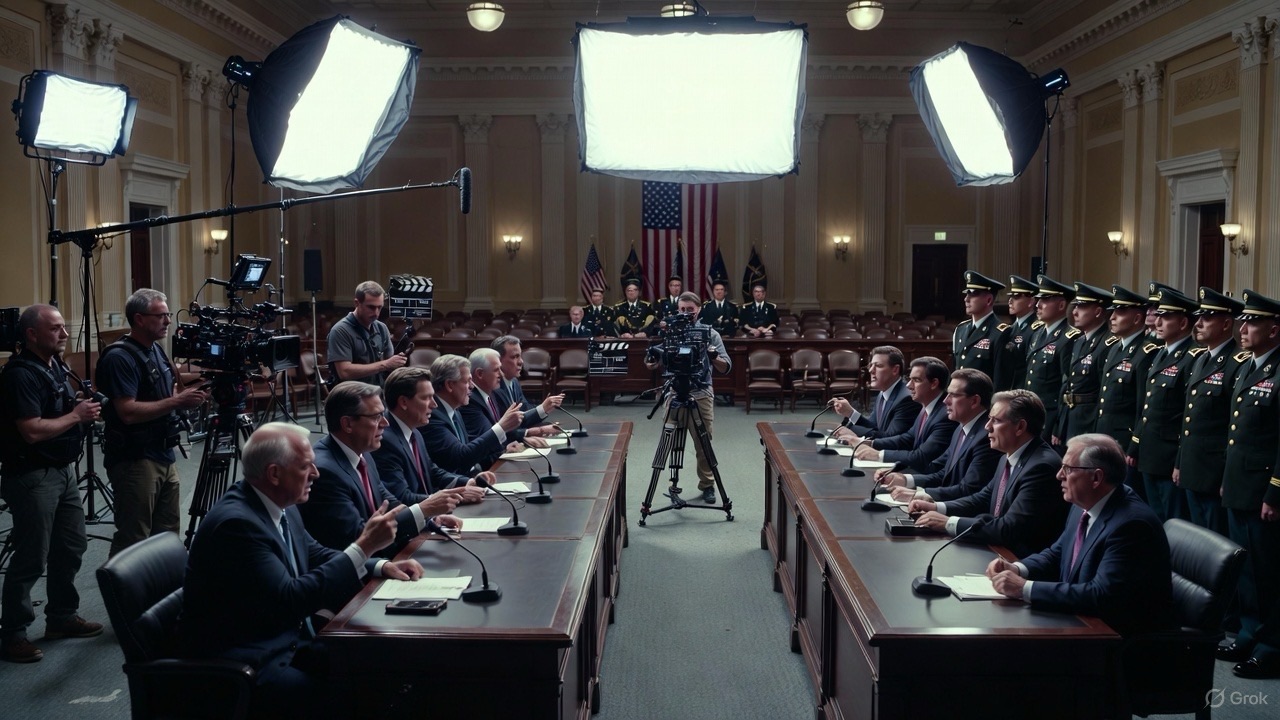
If you watched the recent video of several members of Congress solemnly warning the military to “refuse illegal orders,” you might think you were watching a trailer for the next Tom Clancy adaptation.
Heroic backlighting, Somber music, Slow-motion crop zooms on concerned faces.
Lines delivered with the gravity of a moon landing announcement.
It had everything except a fireball in the background, But one thing it absolutely did not have?
A real purpose.
Let’s be honest about what we just witnessed:
This was not a message to the military, This was a message to us — the audience — carefully engineered for emotional reaction.
It was never meant to inform. Never meant to warn. Never meant to clarify legal boundaries for service members.
It was built for one reason, and one reason only:
💥 Outrage engagement.
And like every Hollywood-style political production before it, it worked flawlessly.
🎥 The Video Was Never About Illegal Orders
You don’t need a classified briefing to understand why this video is pure theater.
Here’s what we know:
No illegal military orders have been issued. No court, tribunal, agency, or legal authority has declared otherwise. There is no active crisis in the chain of command. The military already knows how to handle illegal orders — it’s baked into UCMJ.
So who exactly was this video for?
Not the Pentagon. Not the Joint Chiefs. Not service members.
The video was designed for us — the public — because we are the ones with thumbs that swipe, hearts that button, and nervous systems that respond to threat cues like a lab rat hearing a bell.
This wasn’t a civic announcement. It was a content drop. And Congress, knowingly or not, is now operating like a Hollywood marketing studio.
🎬 Outrage as a Production Industry
We need to stop pretending our political class is full of public servants sending messages to institutions, because they’re not.
They’re sending messages to the algorithm.
When a politician appears in a perfectly lit, professionally edited, slow-cut cinematic “warning,” we are not watching governance. We are watching branding.
And the formula is always the same:
Identify a fear. Package it as imminent. Shoot it like a movie trailer. Release it into the bloodstream of social media. Collect engagement from the resulting outrage war.
This congressional video is simply the latest in a long line of manufactured cinematic crises.
Remember:
The “Handmaid’s Tale” protest videos The overproduced January 6 committee ads The GOP “This Is What Biden’s America Looks Like” dystopia trailer The celebrity-led “fight for democracy” stylized PSAs The “Dark Brandon” campaign ads with Marvel lighting The “MAGA Apocalypse” compilation reels Even COVID PSAs were shot like pharmaceutical dramas
We’re not being governed. We’re being marketed to.
🎞 Hollywood Has Moved Into Congress — and Brought Its Tricks
Here’s what Hollywood figured out decades ago:
🔥 Stronger emotions = bigger audience
🔥 Bigger audience = more revenue
🔥 Fear & conflict outperform calm & nuance 10:1
Now swap “revenue” for “votes” or “outrage engagement” and you’ve got the exact same model.
Congressional comms teams now:
hire former film editors, use commercial-grade equipment, storyboard videos, rehearse lines, color-grade footage, curate the soundtrack, test messaging with digital teams
Meanwhile, we pretend this is “communication” rather than content engineering.
The military doesn’t need to be told their legal obligations in a movie-trailer voiceover.
The only people who needed this video were the viewers — so they would react.
And react we did.
🔥 The Outrage War the Video Was Designed to Trigger
This video triggered both tribes exactly as intended. The Left interpreted it as:
“He’s dangerous. He’ll issue illegal orders. We must be vigilant.”
The Right interpreted it as:
“This is disloyal. This undermines the chain of command. This is treason.”
Both groups were provoked. Both groups felt threatened. Both groups began attacking each other.
And in the comments section, on X, on Facebook, on YouTube — the war exploded.
Engagement for all. Clicks for all. Visibility for all. Nothing brings out the tribal energy faster than a cinematic warning.
This wasn’t about informing the public. It was about activating the public.
🎭 Crisis-as-Content Is the New Norm
There is no actual military crisis. There is no insubordination epidemic. There is no illegal-order scandal.
But there is an engineered content ecosystem that demands a crisis every week. Because “calm and stable” doesn’t go viral. “Hypothetical maybe-crisis in 2027” doesn’t trend.
But “TREASON?” does.
“ILLEGAL ORDERS?” does.
“REFUSE THE PRESIDENT!” does.
“PUNISHABLE BY DEATH” definitely does.
This was not a message. It was a provocation.
🧠 The DBAC Takeaway
The actors in this cinematic display are not speaking to the military. They’re not speaking to the president. They’re not speaking to experts.
They’re speaking to us — because we are the product.
The outrage algorithm needs content. And Congress just delivered another trailer.
Meanwhile, the rest of us would do well to remember something crucial:
If it looks like a movie, feels like a movie, and is edited like a movie… It’s probably not governing.
It’s marketing.
Don’t be a click.
The crisis isn’t real.
The production is.
Leave a Reply