
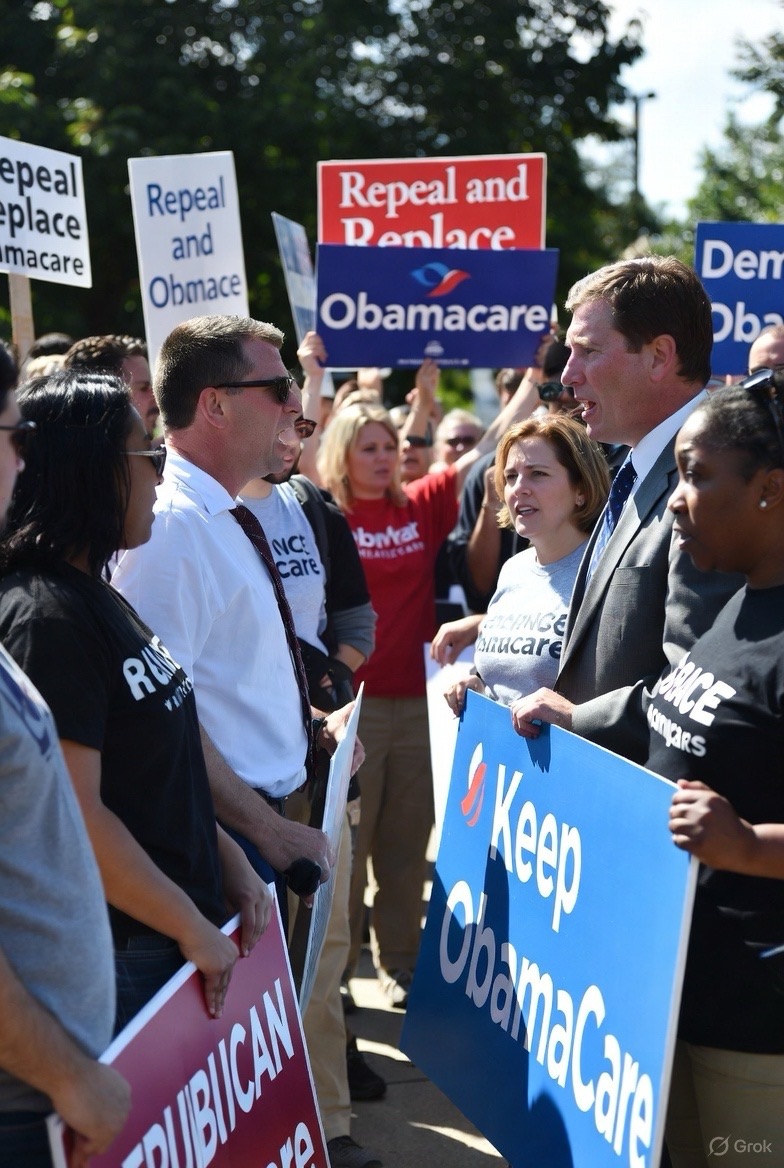
1. Start with the one thing both sides quietly agree on
Beneath the slogans, there is one shared reality:
Enhanced ACA premium subsidies are scheduled to expire at the end of 2025 unless Congress acts.
These “enhanced premium tax credits” were created in 2021 and later extended through 2025. They make Marketplace coverage cheaper by increasing the subsidy and expanding eligibility above 400% of the poverty line.
If they expire under current law, independent analyses estimate:
Marketplace premiums would more than double on average for affected enrollees (about $1,000 more per year on average).
Roughly 4–5 million people could become uninsured, and 7+ million would lose subsidized coverage.
So the baseline truth is this:
Doing nothing = big premium increases for millions of people.
Everything else is argument over what to do instead.
2. What each side is actually saying (once you strip off the spin)
The Democratic framing
Democrats are saying, in effect:
Republicans have blocked or delayed efforts to extend these enhanced credits.
So the baseline truth is this:
Doing nothing = big premium increases for millions of people.
Everything else is argument over what to do instead.
2. What each side is actually saying (once you strip off the spin)
The Democratic framing
Democrats are saying, in effect:
Republicans have blocked or delayed efforts to extend these enhanced credits.
Letting them expire means premiums go up and millions risk losing coverage.
So when Hakeem Jeffries posts “Donald Trump wants to raise your healthcare premiums and destroy the ACA”, he’s framing inaction on extending subsidies and longstanding GOP hostility to the ACA as an active desire to raise costs and undermine the law.
It’s emotionally loaded language built on this logic:
“You know these subsidies are cutting people’s premiums. If you oppose keeping them, you’re choosing higher premiums.”
The Republican framing
Republican leaders are saying:
The current subsidies are temporary and expensive, and extending them permanently would add hundreds of billions to the deficit.
They want “reforms” they claim will cut costs in other ways: more direct cash assistance, expanded HSAs, different subsidy formulas, or more “choice” and “competition.”
So when Speaker Mike Johnson promises GOP reforms “to cut healthcare costs as ACA subsidies expire,” the key phrase is “as subsidies expire” — he’s accepting that expiration as the default, and saying their alternative approach will be better for consumers.
That’s a different logic:
“These subsidies were always temporary. Let’s replace them with something else we think is better.”
3. Why it feels impossible to know who’s telling the truth
Because they are telling two different truths about two different baselines:
Democrats compare everything to “keep enhanced subsidies in place.” Anything less = “raising premiums” / “destroying the ACA.” Republicans compare everything to “let the temporary subsidies lapse and do something new.” Anything they propose afterward = “cutting costs” / “reforming healthcare.”
Both can sound true inside their own framing.
But neither tweet tells you the full picture:
The Democrat tweet doesn’t mention the cost or temporary nature of the enhanced credits. The Republican messaging doesn’t mention that letting them expire means big premium hikes for many people in the short term, especially low- and middle-income families.
That gap between what’s said and what’s left out is where the confusion lives.
4. A DBAC method for navigating this kind of fight
The DBAC project isn’t about telling you which policy to support.
It’s about protecting your brain from weaponized narratives so you can look for reality.
Here’s a simple checklist you can offer people:
Step 1 – Ask: “What is the actual thing happening under current law?”
In this case:
Enhanced ACA premium tax credits end after 2025 unless Congress extends them.
That’s the starting point. Not the tweet. Not the speech. The statute.
Step 2 – Separate three different questions
What happens if Congress does nothing? → Premiums go up for millions; millions may lose coverage.
What is each side proposing instead? → Democrats mostly want to extend the enhanced credits (often permanently or for several years).
→ Republicans are talking about letting them expire and replacing them with other tools (different subsidies, HSAs, etc.), though details and unity are far from settled.
Who benefits and who pays under each option? → That’s where independent analyses from KFF, Urban Institute, Commonwealth Fund, bipartisan think tanks, and CBO are more useful than party press releases.
Step 3 – Notice the verbs
Watch the specific verbs used in political messaging:
“wants to raise your premiums” “destroy the ACA” “cut your costs” “protect your care”
These are moral verbs, not descriptive verbs.
They translate to:
“They’re the villain.” “We’re the hero.”
A DBAC mind asks:
“What specific policy change are they talking about, and what do neutral sources say it would do?”
Step 4 – Look for numbers, not just villains
When an argument is real, you’ll see:
Dollar amounts (average premium changes, budget impact) Head counts (how many people gain or lose coverage) Time frames (what happens next year vs ten years out)
When an argument is pure emotional bait, you’ll mostly see:
names of hated or loved politicians words like “destroy,” “attack,” “fight,” “protect,” “wreck,” “save” no links to independent data
In this debate, independent estimates are pretty consistent:
ending the enhanced credits means higher premiums and millions losing or dropping coverage, especially among lower-income and self-employed people.
What those numbers mean, and what trade-offs are acceptable, is a political question.
But the numbers themselves are not partisan.
Step 5 – Remember: tribes sell a feeling, not a full explanation
Each side is offering you a story:
“They want to hurt you, we want to protect you.” “They’re reckless, we’re responsible.”
But neither camp is responsible for your understanding.
Their job is to win.
Your job — if you don’t want to be a click — is different:
Find the baseline. Understand what’s expiring or changing. Check neutral or mixed-leaning sources for concrete effects. Then decide what you think.
5. In closing:
You can’t stop politicians from framing everything as an existential good vs evil showdown. That’s the business model.
But you can refuse to let your brain be dragged back and forth like a rope in their tug-of-war.
In the ACA subsidy fight:
One side is yelling, “They want to raise your premiums and destroy your healthcare.” The other is yelling, “We’re going to cut your costs with reforms once these expensive subsidies end.”
The quiet truth underneath both slogans is:
A temporary benefit is ending.
Someone has to decide whether to keep it, change it, or replace it.
Different choices help and hurt different people.
That’s not as exciting as a viral tweet.
But it’s the level where real thinking — and real self-interest — actually starts.
Don’t let the loudest headline decide what you believe.
Reality is still in there. It just takes a little work to find it.
Don’t be a click.
Leave a Reply